| QUICK ANSWER
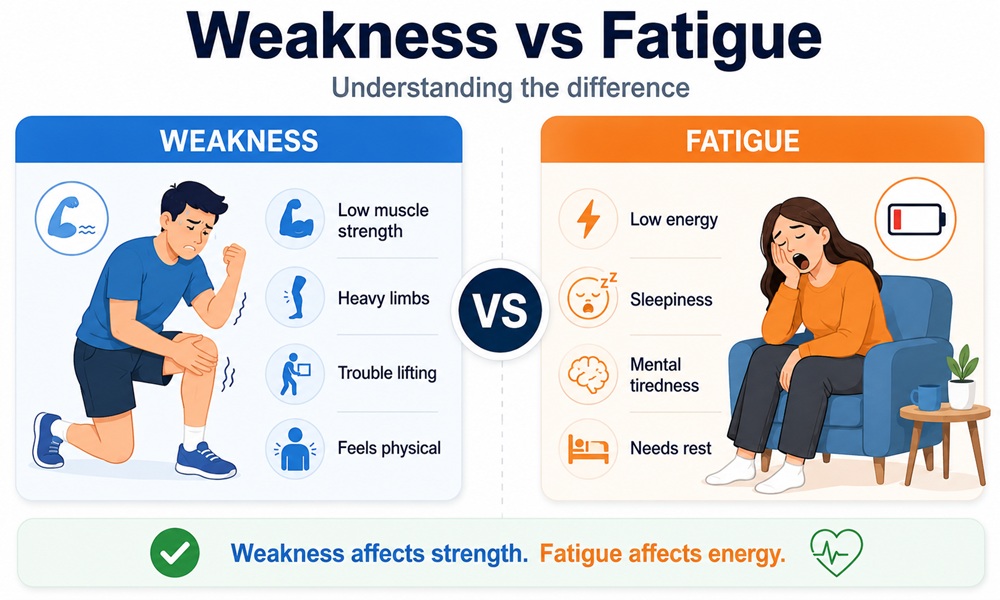
Fatigue is a feeling — a deep lack of energy or motivation, where you could move but do not feel up to it. Weakness is a function — an actual reduction in muscle power, where the muscle cannot do its normal work no matter how hard you try. In short, fatigue is ‘I have no energy’; true weakness is ‘my muscle will not respond.’ |
People use ‘weak’ and ‘tired’ to mean the same thing, but to a doctor they point in different directions. Getting the distinction right helps explain what is going on — and when to worry.
A simple way to picture it
Imagine a phone. Fatigue is a battery running low — the phone still works, it just needs charging (rest, sleep, food). Weakness is a hardware fault — a button that no longer responds however much you charge it. Rest fixes a low battery; it does not fix a broken button.
Defining each clearly
Fatigue
Fatigue is a whole-body sense of exhaustion, low drive, or mental tiredness. You can usually still perform a task, but it feels effortful. It often improves with rest, sleep, hydration, and good nutrition.
Weakness
Weakness (sometimes called asthenia when generalised) is a measurable loss of strength. You try to lift, grip, or stand and the muscle simply cannot deliver. It does not reliably improve with rest, and when it affects one side or one area, it can be an important neurological clue.
Weakness vs fatigue: comparison
| Feature | Fatigue | Weakness |
| What it is | Lack of energy/drive | Loss of muscle power |
| Can you do the task? | Yes, but it feels hard | No, or only partly |
| Helped by rest? | Usually yes | Often not |
| Spread | Whole-body, general | Can be focal (one limb/side) or general |
| Typical drivers | Sleep loss, stress, anaemia, illness | Nerve/muscle issues, electrolytes, infection |
Common causes
Causes that lean toward fatigue
- Poor or short sleep; overwork and stress.
- Anaemia (low iron), thyroid problems, infections.
- Dehydration, poor nutrition, low mood or anxiety.
Causes that lean toward true weakness
- Nerve or muscle conditions.
- Electrolyte imbalances (low potassium, sodium, or calcium).
- After-effects of serious infection or prolonged illness.
| TRUE WEAKNESS RED FLAGS — URGENT
Seek emergency care for sudden weakness — especially on one side of the body, or with a facial droop, slurred speech, confusion, or trouble walking. These can be signs of a stroke. Also urgent: rapidly spreading weakness, weakness with breathing or swallowing difficulty, or weakness after a fall or injury. |
Why the difference matters
Fatigue is extremely common and usually responds to lifestyle changes and treating any underlying cause like anaemia. True, focal weakness is treated more seriously because it can point to a nerve, muscle, or brain problem that needs prompt evaluation. Telling a doctor ‘I feel drained’ versus ‘my arm will not lift’ sends them down very different paths.
How doctors approach it
Because the words overlap, a clinician will often test your actual muscle power, ask precisely what you can no longer do, and note whether the problem is focal (one area) or generalised. Simple blood tests can check for anaemia, thyroid problems, vitamin levels, and electrolyte imbalances — all common, treatable causes of low energy.
Everyday steps for ordinary tiredness
- Protect your sleep: consistent timing, and 7–9 hours for most adults.
- Eat regular, balanced meals and stay hydrated.
- Move daily — light activity often boosts energy more than rest does.
- Manage stress and limit late-night screens, alcohol, and excess caffeine.
- Check in on mood — low mood and anxiety are common, often-missed energy drains.
These help genuine fatigue. They will not fix true weakness — which is the very reason the distinction matters. If strength does not return with rest and good habits, it is time to be assessed.
The bottom line: fatigue is ‘I have no energy’ and usually eases with rest, sleep, and treating causes like anaemia. Weakness is ‘my muscle won’t respond’ and, especially when sudden or one-sided, needs prompt medical attention.
FAQ
Can fatigue feel like weakness?
Yes — severe fatigue can make your whole body feel heavy and ‘weak’. The test is whether the muscle can still do its job when you push: if it can but it feels hard, that is fatigue; if it genuinely cannot, that is weakness.
What deficiency causes weakness and fatigue?
Iron deficiency (anaemia), low vitamin B12 or vitamin D, and electrolyte imbalances are common contributors. A simple blood test can check these.
When should I see a doctor for tiredness?
If fatigue lasts more than a couple of weeks, is not relieved by rest, or comes with weight loss, breathlessness, or other symptoms, get it checked.
Note: General information only. Sudden weakness can be an emergency — do not wait.